Free vibration without damping
Equation of motion for a mass spring system:
$$ m y''(t) + k y(t) = 0 $$
where \(m\) is the mass and \(k\) is the spring constant. Using the definitions
$$ w_0^2 = \frac{k}{m} $$
equation can be written as
$$ y''(t) + w_0^2 y(t) = 0 $$
The general solution is:
$$ y(t) = c_1 sin(w_0 t) + c_2 cos(w_0 t) $$
where \(c_1, c_2\) are unkown constants that can be determined by the given initial position and velocity:
$$ y(0) = y_0 $$ $$ y'(0) = v_0 $$
Then the solution
$$ y(t) = y_0 cos(w_0 t) + \frac{v_0 sin(w_0 t)}{w_0} $$
Example 1: No damping
$$ y''(t) + 4y(t) = 0, y(0)=1, y'(0)=0 $$
solution:
$$ y(t) = cos(2 t) $$
Free Vibration with Damping
$$ m y''(t) + c y'(t) + k y(t) = 0 $$
$$ m λ^2 + c λ + k = 0 $$
$$ λ_{1,2} = \frac{-c \pm \sqrt{c^2 - 4 k m}}{2 m} $$
$$ y(t) = α_1 e^{λ_1 t} + α_2 e^{λ_2 t} $$
- Overdamping \(c^2 > 4 k m\) roots are real and negative.
- Critical damping \(c^2 = 4 k m\) roots are real and negative and identical
- Underdamping \(c^2 < 4 k m\) roots are complex conjugates with negative real part.
- No damping \(c=0\) roots are pure complex conjugates
Example 1: Overdamping
$$ y''(t) + 5 y'(t) + 4y(t) = 0, y(0)=1, y'(0)=0 $$
solution:
$$ y(t) = \frac{1}{3} (4 e^{-t} - e^{-4 t}) $$
Example 2: Critical damping
$$ y''(t) + 4 y'(t) + 4y(t) = 0, y(0)=1, y'(0)=0 $$
solution:
$$ y(t) = e^{-2 t} (2 t + 1) $$
Example 3: Under damping
$$ y''(t) + 2 y'(t) + 4y(t) = 0, y(0)=1, y'(0)=0 $$
solution:
$$ y(t) = e^{-t} (\frac{1}{\sqrt{3}} sin(\sqrt{3} t) + cos(\sqrt{3} t)) $$
Forced vibration without damping
Equation of motion for a mass spring system:
$$ m y''(t) + k y(t) = F_0 cos(w t) + mg $$
where \(m\) is the mass and \(k\) is the spring constant. Using the definitions
$$ w_0^2 = k/m , A = F_0/m $$
equation can be written as
$$ y''(t) + w_0^2 y(t) = A cos(w t) + g $$
The general solution is:
$$ y(t) = c_1 sin(w_0 t) + c_2 cos(w_0 t) + \frac{A cos(w t)}{w_0^2 - w^2} + \frac{g}{w_0^2}$$
where \(c_1, c_2\) are unkown constants that can be determined by initial conditions:
$$ y(0) = \frac{g}{w_0^2} $$ $$ y'(0) = 0 $$
Then the solution
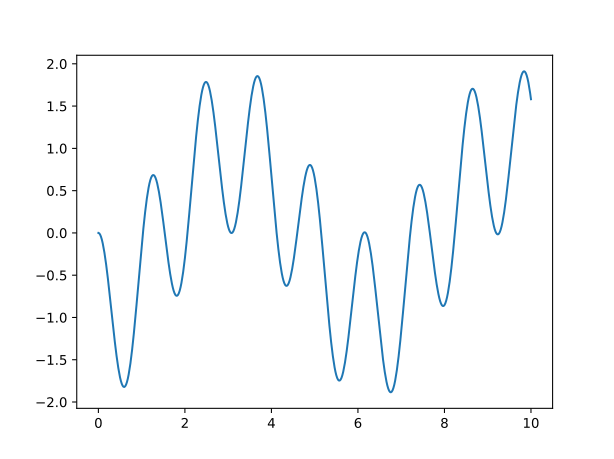
$$ y(t) = \frac{A (cos(w_0 t) - cos(w t)) }{w^2 - w_0^2} + \frac{g}{w_0^2} $$
Gravity changes only the equilibrium position, does not change the dynamics.
Resonance
If the forcing frequency equal to natural frequency
$$ y''(t) + w_0^2 y(t) = A cos(w_0 t)$$
General solution
$$ y(t) = c_1 sin(w_0 t) + c_2 cos(w_0 t) + \frac{A t sin(t w_0)}{2 w_0} $$
with the same initial conditions without gravity ( \(g=0\) ) the solution is
$$ y(t) = \frac{A t sin(t w_0)}{2 w_0} $$
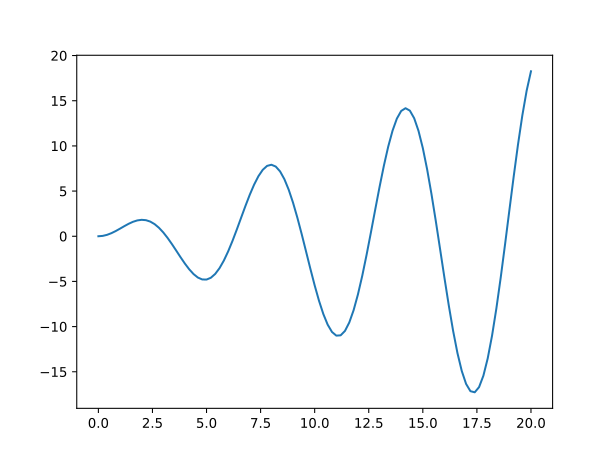
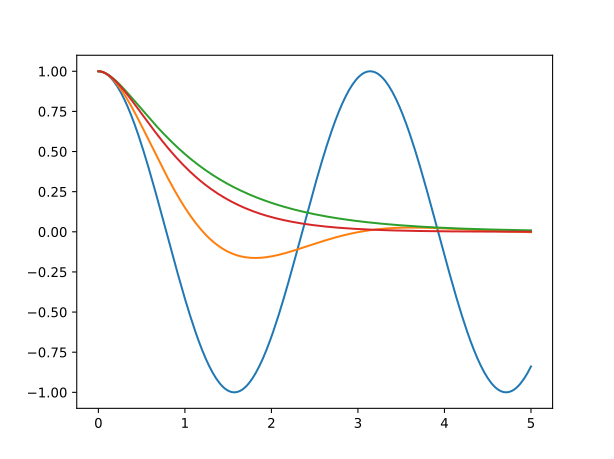 Figure: Green: Over, Red: Critical, Orange: Under, Blue: No damping